News
News
Blue Carbon Dam Project & NSW Curriculum Links
A new study from Deakin University has shown farm dams are a major contributor to climate change (due to microbes releasing carbon dioxide, methane and nitrous oxide).

January 30, 2026
A new study from Deakin University has shown farm dams are a major contributor to climate change (due to microbes releasing carbon dioxide, methane and nitrous oxide) and with over 1.765 million farm dams in Australia, that’s a serious concern.
To put in it context that’s 5,000 square kms, holding 23 times the amount of water in Sydney harbour, and each dam produces roughly the same amount of greenhouse gas emissions as a regular car.
In addition to shining a light on the problem, Deakin University’s Blue Carbon Labs are also promoting a solution. The study’s lead author, Quinn Ollivier, found that dam emissions were caused by dissolved nitrate concentrations, and were significantly higher on livestock farms, compared to cropping areas.
By “minimising excess fertilisation and containing animal effluent”, he estimates nitrate levels could be slashed, and emissions from dams could be halved.
Additionally, while the study found dams had one of the highest emissions of all freshwater ecosystems, they were not accounted for in any governmental greenhouse budgets.
That provided an “enormous opportunity” for governments to work with landholders to manage nutrients, Mr Ollivier said, adding farm dams “may be emitting three times more carbon into the atmosphere than freshwater reservoirs”. “Global satellite networks have only made it possible to correctly assess the distribution of farm dams in the past decade. Landholders may be able to reduce emissions by something as simple as re-plant-ation of native plants along dam edges, this could help to reduce the nutrients entering the dam and therefore the greenhouse gases coming out.”
Astronomical Agriculture School Excursion Alignment
It's this important work from Deakin University that we’ve emulated here at the Australian Agricultural Centre, and when primary school students attend our Astronomical Agriculture program, they’re aligned with this latest thinking, as well as the new NSW Curriculum.
NSW Curriculum Alignment for School Excursions
ES1
STE-SCI-01
Identifies and describes characteristics of living things, properties of materials, and movement
STE-PQU-01
Poses questions based on observations to collect data
STE-DDT-01
Identifies and uses technologies to make products to address user needs or opportunities
S1
ST1-SCI-01
Measures and describes changes in living things, materials, movement, Earth and the sky
ST1-PQU-01
Poses questions based on observations and information to investigate cause and effect
ST1-DAT-01
Collects, represents and uses data to identify patterns and relationships
ST1-DDT-01
Uses technologies and materials to design and make products to address user needs or opportunities
S2
ST2-SCI-01
Uses information to investigate the solar system and the effects of energy on living, physical and geological systems
ST2-PQU-01
Poses questions to create fair tests that investigate the effects of energy on living things and physical systems
ST2-DAT-01
Uses and interprets data to describe patterns and relationships
ST2-DDT-01
Uses a design process to create products to address user needs or opportunities
ST2-DDT-02
Designs and uses algorithms, represents data and uses digital systems for a purpose
S3
ST3-SCI-01
Uses evidence to explain how scientific knowledge can be used to develop sustainable practices
ST3-PQU-01
Poses questions to identify variables and conducts fair tests to gather data
ST3-DAT-01
Interprets data to support explanations and arguments
ST3-DDT-01
Uses design processes to create, evaluate and modify designed solutions
Extension Activities Cover
ST3-DDT-02
Creates, evaluates and modifies algorithms to code or control digital devices and systems
ST3-CWT-01
Creates written texts to communicate understanding of scientific and technological concepts and processes
Want to know when the next Astronomical Agriculture program is running…?
Upcoming Programs
Click here for a full list of programs

Women in AG
Whether you’re new to agriculture or looking to upskill, this Women in Ag course provides a supportive and practical learning environment where you’ll learn real-world skills you can put into action, straight away.

Ag Ready Course – AHC10222 Certificate I in Agriculture
This qualification describes the skills and knowledge required for individuals preparing for entry level work in the agriculture, and conservation and ecosystem management industries.
• 2 x 2 hour sessions per week via Teams over 6 weeks = total 24 hours
• Students need to do at least 4 hours per week self paced learning and complete the knowledge assessment
• On-farm training and assessment – Trainer on-site for 3 days – 6 hours per day – this is to cover practical application and final assessment
• The fee includes resources
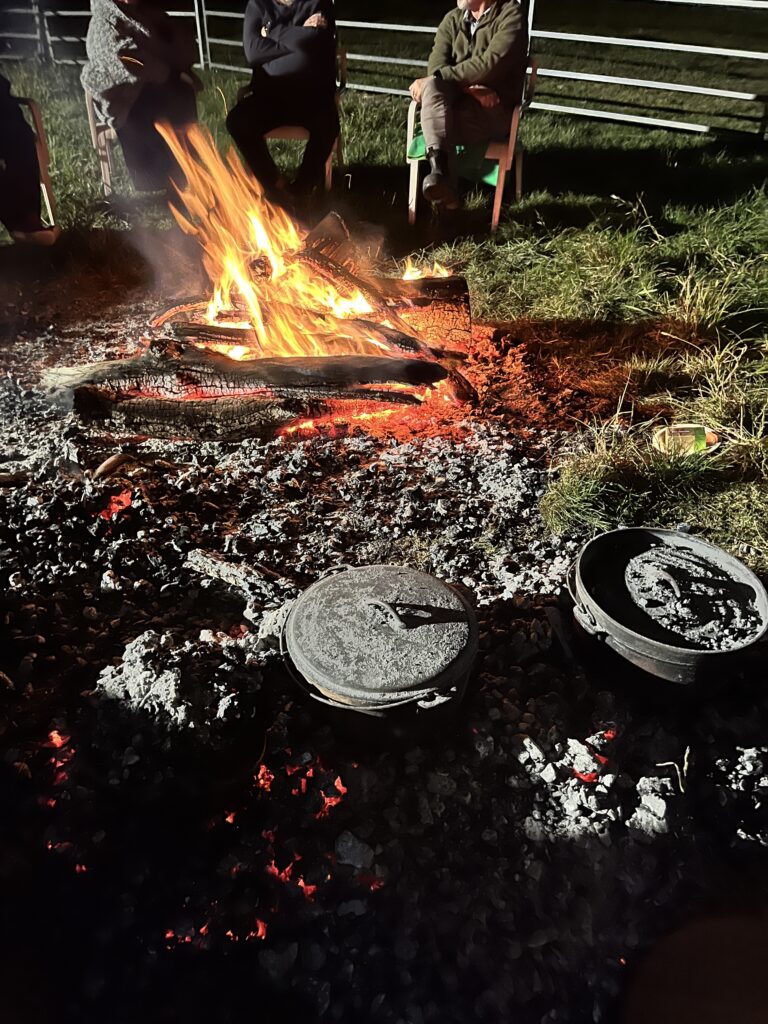
Master the Camp Oven
Master the Camp Oven with Leanne Kelly and discover the essentials of authentic outdoor cooking. Learn how to safely build and manage your fire, heat and control the temperature of your camp oven, and prepare a delicious meal.
After dinner enjoy the amazing night sky through our 20″ telescope.

Astronomical Agriculture – Biodiversity Building Overnight Camp
The Astronomical Agriculture course is an multiple award winning, overnight Primary School Excursion that students, and their teachers (!) have been enjoying for over five years now. Join STEM teachers from the Crookwell Academy of STEM Excellence and local First Nations people on an overnight adventure exploring how to build biodiversity, STEM in agriculture, astronomy and First Nations Culture.

Astronomical Agriculture – Biodiversity Building Day Visit
Join STEM teachers from the Crookwell Academy of STEM Excellence exploring how to build biodiversity and STEM in agriculture.

Novice Shearing Oct 2026
Five full days of training could change your life. Being a sheep shearer is hard work, but it’s incredibly rewarding and this course will take you through every aspect of it with expert guidance, and hands-on experience you simply won’t find anywhere else.


Shearing Taster day
Not everyone’s cut out for the nine to five, and for many of your students life on a farm might as well be another planet, but it doesn’t have to be. This shearer tasting day provides an introduction to sheep shearing, and a career many of your students may not have contemplated before. Led by experienced Australian Wool Innovation (AWI) Instructors, this course is a hands-on, practical day that takes you through every step in the wool harvesting process.
Contact Us
Get Involved
We’re trying to create a welcoming, sustainable agriculture industry that puts producers at the heart of a healthy Australia.
If you’d like to take a course, offer a program or get involved in any way, please get in touch.